The Digital Architect: The Impact of AI on Social Media History
The Impact of AI on Social Media History is not just a modern trend; it is the invisible force that turned simple digital bulletin boards into the most powerful influence engines on Earth. While we often think of social media as a place to share photos with friends, the reality is that Artificial Intelligence has been the “silent architect” behind every scroll, like, and share for over a decade.
To understand where we are today, we must look at how AI transitioned from a simple tool for sorting data into a creative force that now generates the very content we consume .
.
1. The Early Days: From Chronology to Curation (2005–2012)
In the beginning, social media was simple. If you followed 10 people on Twitter or Facebook, you saw their posts in the order they were posted. This was the “Chronological Era.” However, as the number of users exploded, people began to suffer from “information overload.”
This is where we first see the Impact of AI on Social Media History. Platforms realized that if a user follows 500 people, they cannot see everything. Facebook introduced its early algorithms (EdgeRank) to decide what was “important.”
Machine Learning Begins: Early AI was used to rank posts based on “affinity” (how much you interact with someone) and “recency.”
The Shift in User Behavior: For the first time, users didn’t control what they saw; a machine did. This changed the history of digital interaction forever.
2. The Era of the “Interest Graph” (2013–2018)
As we moved into the mid-2010s, AI became much smarter. It stopped looking just at who you were friends with and started looking at what you actually liked. This period marked a massive pivot in the history of social media.
The Rise of the Recommendation Engine
Instagram and Pinterest began using Deep Learning to analyze images. If you liked a photo of a mountain, the AI didn’t just see pixels; it recognized “nature,” “travel,” and “hiking.”
TikTok’s Entry: Perhaps the biggest Impact of AI on Social Media History occurred when TikTok (ByteDance) entered the global stage. Unlike Facebook, which relied on your “Social Graph” (friends), TikTok used a pure “Interest Graph.”
The Result: You could see content from a stranger in another country simply because the AI knew you enjoyed that specific type of humor or niche hobby. This broke the traditional “friend-based” model of social media.
3. AI as the Gatekeeper: Moderation and Safety
We cannot discuss history without looking at the challenges. As social platforms grew, so did hate speech, spam, and misinformation. Human moderators could not keep up with billions of posts per day.
AI became the primary police force of the internet. Computer Vision and Natural Language Processing (NLP) allowed platforms to scan text and images in milliseconds.
Shadowbanning and Filtering: AI began to “softly” remove content that violated policies.
The Conflict: This also introduced “algorithmic bias,” where AI sometimes silenced legitimate voices, creating a new chapter of controversy in social media history.
4. The Turning Point: Generative AI (2023–Present)
The most dramatic Impact of AI on Social Media History happened very recently with the rise of Generative AI. Previously, AI only sorted content. Now, AI creates it.
The Death of Authenticity?
With tools like Midjourney, ChatGPT, and Sora, the line between “real” and “fake” has blurred.
AI Influencers: We now have digital personalities like Lil Miquela who have millions of followers but do not exist in the physical world.
Synthetic Media: The history of social media was always about “User-Generated Content” (UGC). We are now entering the era of “AI-Generated Content” (AIC).
5. How AI Changed Digital Marketing History
For businesses, the impact has been revolutionary. The way brands reach us today is entirely different from the “TV-style” ads of early Facebook.
Hyper-Personalization: AI analyzes your buying habits, your time spent on a post, and even your mouse movements to serve the perfect ad.
Predictive Analytics: Social media companies can now predict what you might want to buy before you even search for it.
Conversational AI: Chatbots have replaced customer service desks, making social media a 24/7 marketplace.
6. The Psychological Impact: The Feedback Loop
Social media history is also a history of human psychology. AI is designed to keep us on the platform for as long as possible. This is called “Engagement Optimization.”
The AI learns your weaknesses. If it sees that you stay longer when you are angry, it will show you more controversial content. This “feedback loop” has led to the polarization of society and changes in mental health trends, which is a significant part of the modern Impact of AI on Social Media History.
7. Looking Toward 2026 and Beyond: The Future History
As we look at the current year, 2026, AI is no longer a feature; it is the platform. We are seeing the rise of “Spatial Social Media” where AI helps create 3D environments for us to hang out in (the Metaverse).
Personal AI Agents: Soon, your personal AI will talk to your friends’ AI to schedule a hangout or summarize the “drama” you missed in a group chat.
Deepfake Integration: Video calls might soon use AI to make us look “perfect” or translate our voice into another language in real-time.
Don’t Miss These: What Are SERP Features in SEO? (Complete Guide)
8. Summary of Key Milestones
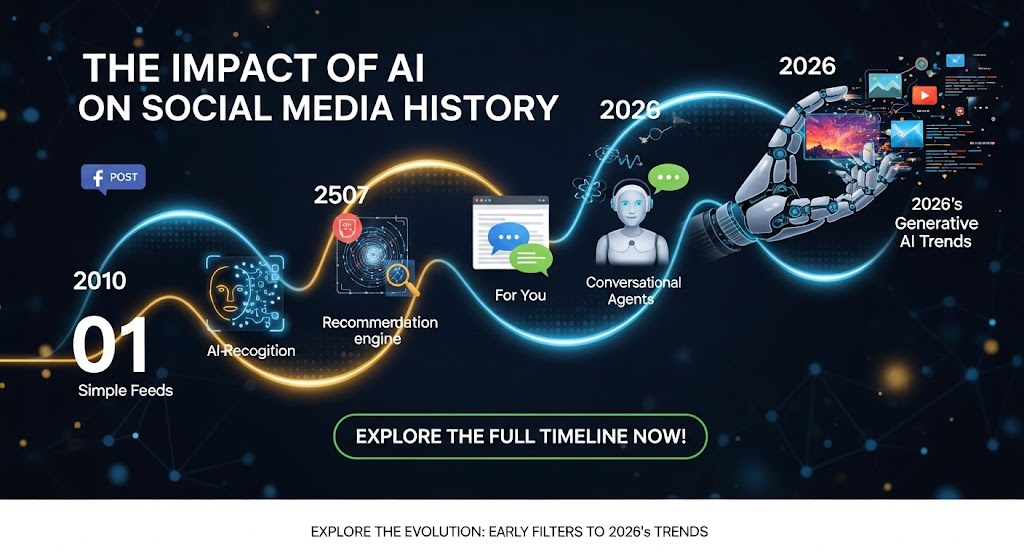
To make this easy to digest, here is a timeline of the Impact of AI on Social Media History:
| Era | Primary AI Role | Key Outcome |
| 2006-2010 | Basic Sorting | End of the Chronological Feed. |
| 2011-2016 | Pattern Recognition | Growth of Targeted Advertising. |
| 2017-2022 | Interest Mapping | The rise of TikTok and viral “niche” content. |
| 2023-2026 | Content Generation | AI Influencers and Synthetic Reality. |
9. The Ethical Dilemma
As AI continues to write the future of social media, we must ask: Who is in control? If an algorithm decides what news you see, it is essentially deciding what you believe. The history of social media has moved from “connecting people” to “managing perceptions.”
However, AI also offers hope. It can translate languages to connect different cultures and help people with disabilities navigate social platforms more easily than ever before.
10. Conclusion
In conclusion, the Impact of AI on Social Media History has been a journey from simple organization to total transformation. It has changed how we find friends, how we buy products, and even how we perceive reality. From the early Facebook filters to the 2026 world of AI-generated video, technology has proven that the “social” part of social media is now deeply intertwined with the “artificial.”
As we move forward, the challenge for users and creators will be to maintain a sense of human connection in an environment built by machines. The history of social media is still being written, and AI is holding the pen.